Role-Based Project Management Software
The 109 Million Dollar Gap: Why Strategy Fails at Execution
February 27, 2026
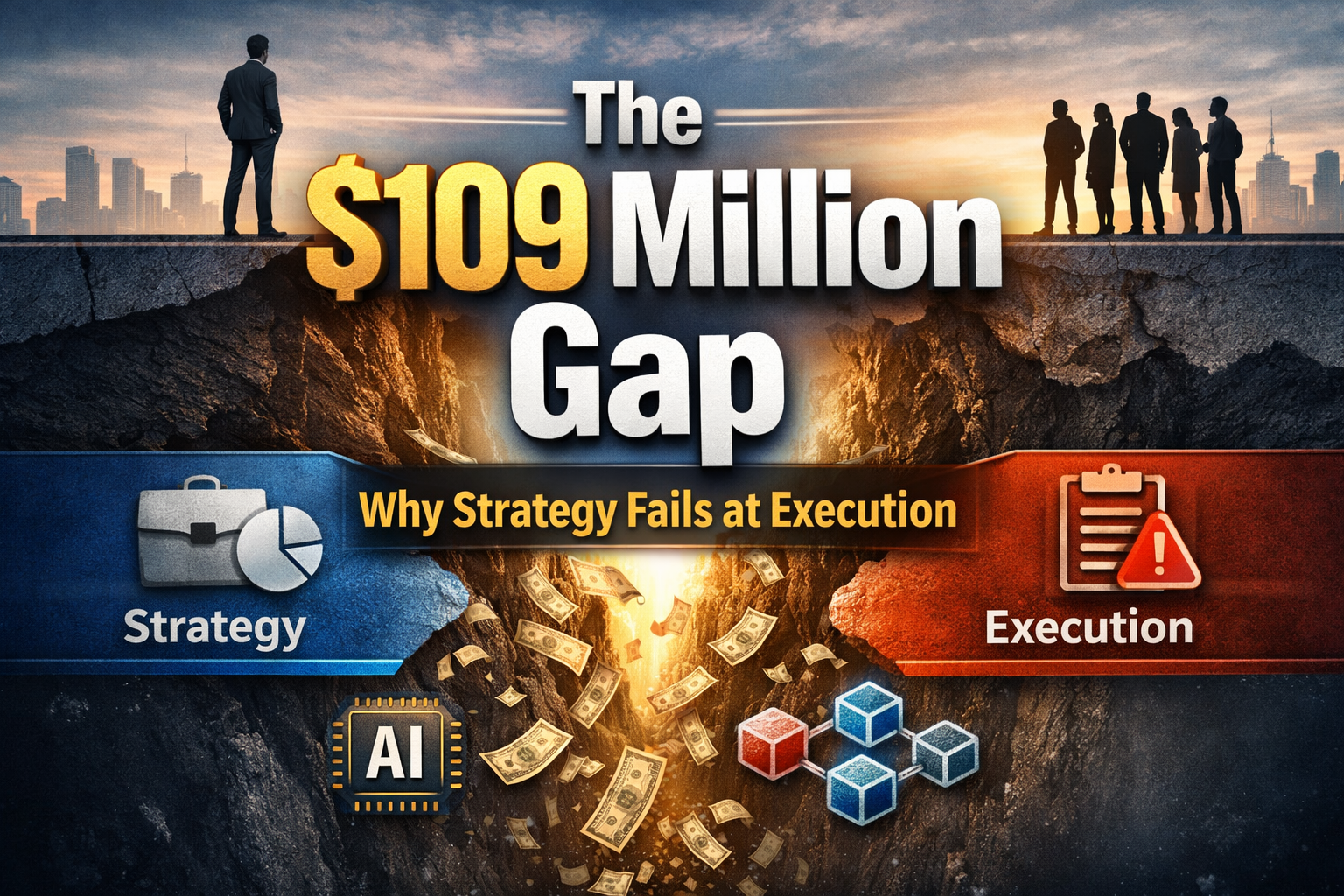
For every one billion dollars invested in projects, organizations waste an average of 109 million dollars due to poor project performance.
This statistic, derived from the Project Management Institute’s (PMI) Pulse of the Profession research, represents more than just a financial leak. It indicates a systemic failure in how modern enterprises bridge the gap between high-level strategy and ground-level execution. When nearly 11% of investment capital evaporates before it yields a return, the issue is rarely a lack of ambition or vision. The problem lies in the disconnect between the boardroom and the project team.
In the current economic climate, where efficiency is paramount, this “execution gap” is the difference between market leadership and obsolescence. This article analyzes the root causes of this waste, specifically focusing on strategic misalignment, and outlines how organizations can transition toward Value-Centric Governance to stop the bleeding.
The Anatomy of Strategic Misalignment
Strategy is often treated as a distinct phase from execution. Executives retreat to off-site planning sessions to define the five-year roadmap, digital transformation goals, and market expansion targets. These strategies are then handed down to the Project Management Office (PMO) or functional heads to implement.
However, the translation of these strategies into tangible project portfolios is where the breakdown begins. According to research from Gartner and other analyst firms, approximately 51% of executives report that their digital transformation initiatives have not resulted in an increase in profitability. This is a staggering figure. It suggests that half of the major strategic initiatives undertaken by modern corporations are effectively “zombie projects”—consuming resources without delivering the intended business value.
The "Black Box" of Execution
The primary driver of this misalignment is the opacity of project execution. Once a project is approved and funded, it often enters a “black box.” Executives receive periodic status reports—usually monthly or quarterly—that rely heavily on manual data entry and subjective interpretation by project managers.
This leads to two critical failures in strategic alignment:
- The Lag Effect: By the time executive leadership realizes a strategic initiative is off track, the data is weeks or months old. The budget has already been consumed, and the window for corrective action has closed.
- The Optimism Bias: Project managers, fearing reprisal or lacking complete data, often report status as “Green” (on track) until the very last moment when it flips to “Red” (critical failure). This phenomenon, often called “Watermelon Reporting” (green on the outside, red on the inside), destroys trust between the C-Suite and the PMO.
Without a direct, transparent line of sight into how daily tasks contribute to strategic goals, the $109 million gap remains impossible to close.
The Data Disconnect: Why Traditional Reporting Fails
To solve the execution gap, we must first address the data disconnect. Traditional project portfolio management relies on static snapshots of data. Spreadsheets, slide decks, and disconnected task management tools create silos where data is trapped.
In many organizations, the “truth” about a project’s health is fragmented across email threads, chat logs, and local files. When a Portfolio Manager attempts to aggregate this information for a steering committee meeting, they are essentially performing archaeology—digging through past records to reconstruct a narrative.
The Integrity Crisis
Beyond the logistical difficulty of aggregating data, there is a crisis of integrity. In highly regulated industries such as finance, healthcare, and government, the provenance of project data is critical. If a project fails to meet regulatory compliance, who is accountable? Was the risk flagged in the status report three months ago, or was the report altered retroactively to cover tracks?
This is where the concept of a “Reliable Organization” becomes essential. Stakeholders and investors need more than just a promise that the project is on track; they need verifiable proof. This demand is driving the adoption of immutable audit trails within PPM software. Technologies that utilize blockchain-style verification for project records are emerging as a necessity, not a luxury. By creating a tamper-proof timestamp for every status report and decision, organizations can establish a single source of truth that stands up to external audit and internal scrutiny.
Moving to Value-Centric Governance
Closing the $109 million gap requires a fundamental shift in project governance. Traditional governance focuses on outputs: Are we on time? Are we on budget? Is the scope contained?
While these metrics are necessary, they are insufficient for ensuring strategic success. A project can be delivered exactly on time and on budget but still fail to deliver any value to the organization if the market has shifted or the strategic premise was flawed.
The solution is Value-Centric Governance, often formalized through Benefits Management (or Benefits Realization Management). This approach shifts the question from “How is the project doing?” to “Is the project still worth doing?”
The Three Pillars of Value-Centric Governance
- Continuous Strategic Validation: Governance should not be a gate that opens only at the beginning and end of a project. It must be a continuous process. Portfolio managers must regularly assess whether the active projects still align with the organization’s evolving strategy. If a competitor releases a disruptive product, does the current portfolio need to pivot? Value-centric governance empowers the PMO to kill or pause projects that no longer align with strategic goals, freeing up capital for higher-value initiatives.
- Outcome-Based Metrics: Instead of measuring success solely by milestones achieved, organizations must track leading indicators of value. For a software project, this might mean tracking user adoption rates during beta testing rather than just code completion. For a construction project, it might involve pre-leasing metrics. Integrating these business metrics into the project portfolio management platform ensures that the project team is focused on the why, not just the what.
- Role-Based Accountability: Value realization is a team sport, but it requires distinct roles. The Project Manager is responsible for the output (the deliverable). The Business Sponsor is responsible for the outcome (the value). Too often, these lines are blurred. Effective governance platforms enforce this distinction, requiring Sponsors to actively validate that the benefits are being realized long after the project team has disbanded.
Bridging the Gap with Integrated PPM Platforms
The theoretical shift to Value-Centric Governance is impossible to execute at scale without the right infrastructure. This is where the next generation of PPM software comes into play. The market is moving away from simple task trackers toward integrated platforms that serve as the nervous system of the enterprise.
The Role of AI in Portfolio Management
Artificial Intelligence is rapidly changing the landscape of project governance. In the context of the $109 million gap, AI serves as an early warning system. By analyzing historical project performance, resource utilization rates, and even the sentiment of team communication, AI models can predict project slippage weeks before a human manager might identify the risk.
Imagine a Virtual PM Assistant that doesn’t just remind you of deadlines but analyzes the quality of requirements documentation. If the AI detects that the scope definition is vague—a leading cause of scope creep—it can flag this risk to the Portfolio Manager immediately. This moves governance from reactive (fixing problems) to proactive (preventing waste).
The Role of Immutable Trust
As mentioned earlier, data integrity is the bedrock of decision-making. Advanced platforms are now incorporating blockchain integration to create “Reliable Organization Seals.” This feature allows organizations to prove to stakeholders—whether they are internal auditors or external investors—that the project data they are viewing is authentic and unaltered. This level of transparency reduces the friction in decision-making. When executives trust the data, they can make faster, more confident decisions about where to allocate capital.
Democratizing Project Management
Finally, bridging the gap requires inclusivity. Project management is no longer the exclusive domain of certified PMPs. In a modern enterprise, team members, resource managers, financial controllers, and external partners all contribute to the project ecosystem.
Effective platforms recognize this by offering role-based interfaces. A Team Member needs a simple view of their tasks and time entry. A Resource Manager needs a heat map of capacity. A Sponsor needs a high-level dashboard of ROI. By tailoring the experience to the role, organizations increase adoption and data quality. When the barrier to entry is lowered—perhaps through freemium models for non-managerial roles—the organization captures a more complete picture of reality.
Conclusion: The Path to High-Performance Execution
The $109 million wasted for every billion invested is not an inevitable cost of doing business. It is a tax on inefficiency, opacity, and misalignment.
To recover this lost capital, organizations must:
- Acknowledge that strategic alignment is a continuous process, not a one-time setup.
- Move beyond “watermelon reporting” by implementing systems that ensure data integrity and transparency.
- Adopt Value-Centric Governance that prioritizes business outcomes over simple output metrics.
- Leverage modern PPM software that integrates AI for predictive insights and immutable ledgers for trust.
The gap between strategy and execution is where value is lost, but it is also where competitive advantage is found. By tightening the link between the C-Suite’s vision and the project team’s daily work, organizations can stop the waste and start realizing the full potential of their investments.
Key Takeaways
- The Cost of Failure: Organizations lose 10.9% of investment due to poor project performance.
- The Strategy Disconnect: 51% of digital transformations fail to yield profit due to execution gaps.
- Governance Shift: Move from tracking time/budget to tracking business value and benefits realization.
- Technology Enablers: Utilize AI for predictive risk analysis and blockchain-enabled audit trails to ensure data trust.
- Unified Vision: Success requires a platform that connects all stakeholders, from the Sponsor to the Team Member, in a single source of truth.