Role-Based Project Management Software
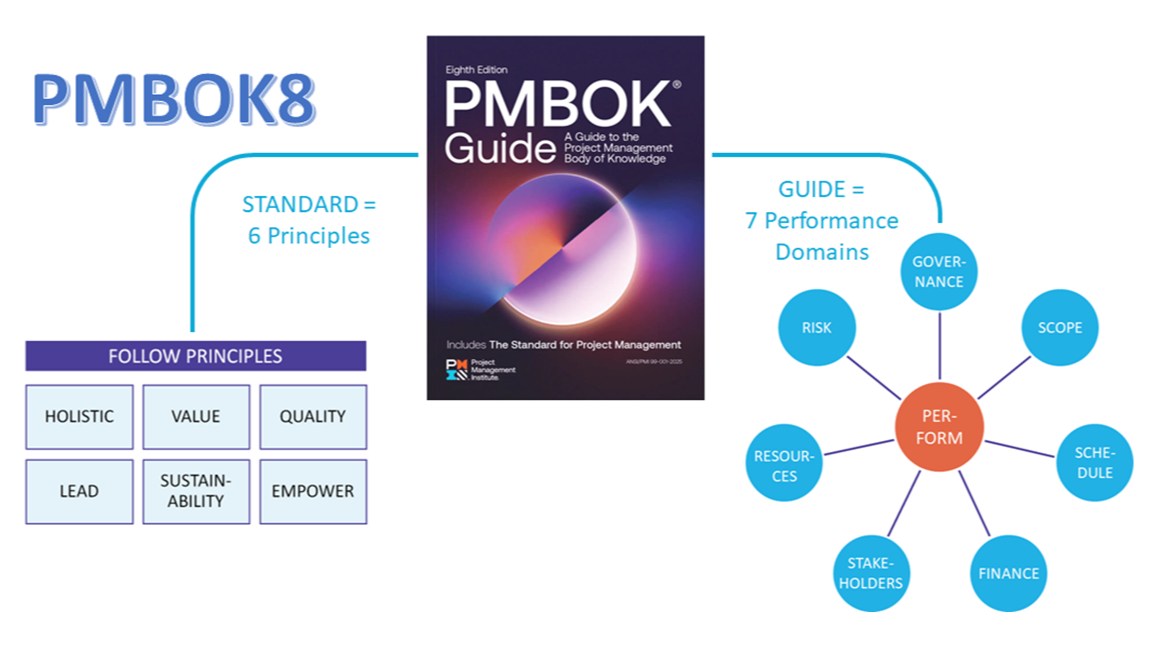
PMBOK® 8th Edition is Out!
Now you can download the 8th edition of the PMBOK®—the best-selling foundational standard periodically issued by PMI since 1996—from the PMI website: https://www.pmi.org/standards/pmbok
The main changes from PMBOK 7 are:
- Processes are reintroduced.
- Project management principles are reduced by half.
- Project performance domains are now process-driven.
1) Processes are reintroduced
“The Guide to the Project Management Body of Knowledge” 8th Edition includes 40 processes, aligned with 7 performance domains and organized within the same process groups—renamed as focus areas—as in the PMBOK® 6th Edition.

Compared to the PMBOK® 6th Edition, the old 10 knowledge areas have been replaced by 7 performance domains:
- The Project Integration Management knowledge area is now the Project Governance performance domain.
- Cost has been renamed to Finance.
- Stakeholders performance domain now includes Communications.
- Project Quality Management is now treated as a behavioral principle.
- Project Procurement Management has been moved to an annex.
PMBOK® 6th Edition standardized 49 processes organized in 10 knowledge areas (chapters 4 to 13) and 5 process groups:

2) Project management principles are reduced by half
“The Standard for Project Management” 8th Edition includes 6 principles (check the 12 principles of PMBOK7 at the end of this article):
- Adopt a HOLISTIC View: Adopt a holistic view throughout the project life cycle‚ from initiation all the way to execution and closing‚ ensuring seamless integration and alignment at every stage.
- Focus on VALUE: Continually evaluate and adjust project alignment to business objectives and intended benefits and value.
- Embed QUALITY into Processes and Deliverables to maintain a consistent focus on achieving target quality thresholds. This emphasis on quality helps to ensure outcomes that meet project objectives and align with the needs, requirements, and acceptance criteria set by relevant stakeholders.
- Be an Accountable LEADER: Demonstrate leadership behaviors and be an accountable leader by guiding your team with integrity, making responsible decisions, and fostering a culture of trust and responsibility.
- Integrate SUSTAINABILITY Within All Project Areas: Consistently integrate sustainability practices across all project areas, through all phases of the project life cycle, as project managers, teams, and sponsors are all jointly accountable for ensuring this integration.
- Build an EMPOWERED Culture that fosters proactive collaboration and promotes unity in shared objectives efficiently and effectively through stakeholders and teams with diverse skills, knowledge, and experience.

3) Project performance domains are now process-driven
“The Guide to the Project Management Body of Knowledge” 8th Edition includes 7 process-driven PERFORMANCE DOMAINS (check the 8 performance domains of PMBOK7 at the end of this article):
- GOVERNANCE: Processes required to make decisions that protect and enhance the value proposition of a project in an integrated and holistic manner, including the authority to cancel a project when necessary.
- SCOPE: Processes necessary to define, develop, monitor, control, and verify the scope of a project, ensuring alignment with stakeholder expectations and project objectives.
- SCHEDULE: Processes required to manage the timely completion of the project.
- FINANCE: Processes required to determine, manage, and control the finances of the project.
- STAKEHOLDERS: Processes required to determine, manage, and control the stakeholder engagement of the project.
- RESOURCES: Processes required to plan, estimate, and acquire the resources needed to successfully complete the project, lead the project team, and control resources. These processes help ensure that the right resources will be available to the project manager and project team at the right time and place.
- RISK: Processes required to conduct risk management planning, identification, analysis, response planning, response implementation, and risk reviews on a project. The objectives of this performance domain are to increase the probability and impact of positive risks while decreasing the probability and impact of negative risks. This approach accelerates project resilience, reduces uncertainty, and increases the chances of project success.
Remembering PMBOK7✝️
PMBOK7 included 12 principles and 8 performance domains, most of them are gone in PMBOK8:

“The Guide to the Project Management Body of Knowledge” 7th Edition included 8 PERFORMANCE DOMAINS:
- STAKEHOLDERS: The project needs a productive working relationship with stakeholders throughout the life cycle. Stakeholders who are project beneficiaries should be supportive and satisfied; stakeholders who may oppose the project or its deliverables should not negatively impact project results.
- TEAM: The project team should be high performance, empowered, resilient and aligned with objectives. They should trust each other and keep ownership of deliverables and outcomes in a collaborative environment.
- DEVELOPMENT APPROACH AND LIFE CYCLE: The project should follow a lifecycle –predictive, adaptative, or hybrid – which is consistent with the development approach for the project deliverables. The series of phases of the project lifecycle should help governance and project termination if strategic criteria are no longer realizable.
- PLANNING: Project managers should visualize next week, next month, how to get the project done, etc. The planning model should be holistic, including the component needed to manage stakeholder expectations, and progressively elaborated as new information is discovered.
- PROJECT WORK: Status reports should demonstrate that project work is efficient and effective. Quality assurance should show that the processes are relevant and effective. The project communications should be effective to engage stakeholders. Procurement and material resources should be managed properly. Projects using a predictive approach should have an integrated change management procedure. Projects using an adaptive approach should have an updated product backlog. The project team should minimize rework and optimize velocity.
- DELIVERY: Project should demonstrate alignment to the organizational strategy and business. Project benefits should be realized in the time frame in which they were planned. Deliverables should be validated, and requirements should be met”.
- MEASUREMENT: At each project review meeting, measurements should indicate whether the project is performing as expected or if there are variances, in order to take timely and informed decisions and actions.
- UNCERTAINTY: The project management team should be alert to anticipate any opportunity or threat which may have a positive or negative effect on a project’s objective or value delivery.
“The Standard for Project Management” 7th Edition included 12 PRINCIPLES:
- Be a diligent, respectful, and caring STEWARD: Stewards act responsibly to carry out activities with integrity, care, and trustworthiness while maintaining compliance with internal and external guidelines. They demonstrate a broad commitment to financial, social, and environmental impacts of the projects they support.
- Create a COLLABORATIVE project team environment: Project teams are made up of individuals who wield diverse skills, knowledge, and experience. Project teams that work collaboratively can accomplish a shared objective more effectively and efficiently than individuals working on their own
- Effectively ENGAGE with stakeholders: Engage stakeholders proactively and to the degree needed to contribute to project success and customer satisfaction.
- Focus on VALUE: Continually evaluate and adjust project alignment to business objectives and intended benefits and value.
- Recognize, evaluate, and respond to SYSTEM interactions: Recognize, evaluate, and respond to the dynamic circumstances within and surrounding the project in a holistic way to positively affect project performance.
- Demonstrate LEADERSHIP behaviors: Demonstrate and adapt leadership behaviors to support individual and team needs.
- TAILOR based on context: Design the project development approach based on the context of the project, its objectives, stakeholders, governance, and the environment using ‘just enough’ process to achieve the desired outcome while maximizing value, managing cost, and enhancing speed.
- Build QUALITY into processes and deliverables: Maintain a focus on quality that produces deliverables that meet project objectives and align to the needs, uses, and acceptance requirements set forth by relevant stakeholders.
- Navigate COMPLEXITY: Continually evaluate and navigate project complexity so that approaches and plans enable the project team to successfully navigate the project life cycle.
- Optimize RISK responses: Continually evaluate exposure to risk, both opportunities and threats, to maximize positive impacts and minimize negative impacts to the project and its outcomes.
- Embrace adaptability and RESILIENCE: Build adaptability and resiliency into the organization’s and project team’s approaches to help the project accommodate change, recover from setbacks, and advance the work of the project.
- Enable CHANGE to achieve the envisioned future state: Prepare those impacted for the adoption and sustainment of new and different behaviors and processes required for the transition from the current state to the intended future state created by the project outcomes.