Role-Based Project Management Software
The 10% Reality: Closing the Strategy-Execution Gap
May 11, 2026
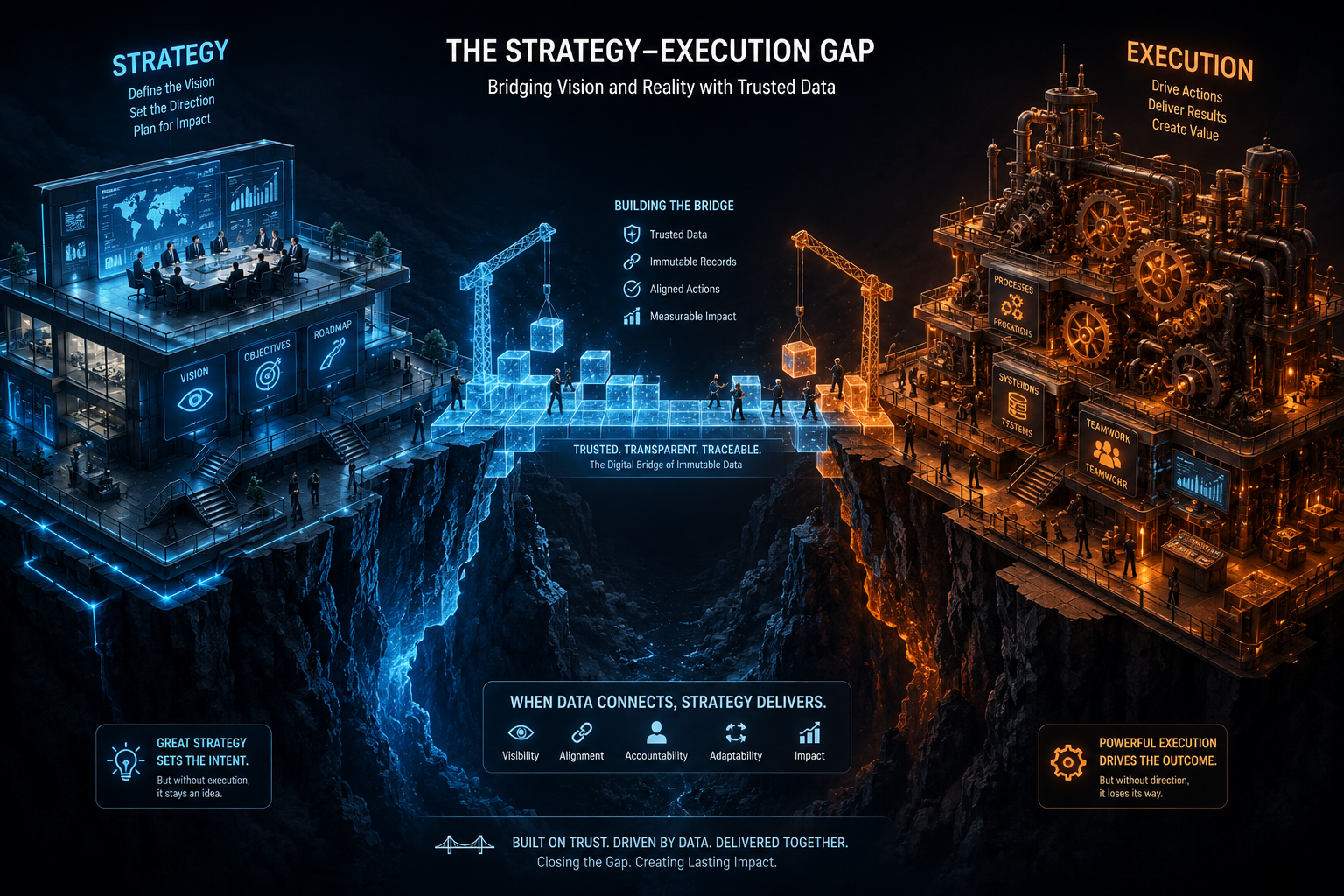
If you place a bet on a large-scale enterprise initiative, the odds are overwhelmingly against you. According to data from the Standish Group’s long-running CHAOS reports, large projects—defined as those with labor costs exceeding $10 million—have a success rate of virtually zero. To be precise, the success rate hovers around 10 percent.
This statistic is not a rounding error. It is a structural indictment of how modern enterprises manage complex work. When nine out of ten major initiatives fail to deliver their intended value on time and within budget, we are not looking at a competency issue among project managers. We are looking at a systemic failure in project portfolio management and the architecture of decision-making itself.
The implications of this failure rate are staggering, yet often accepted as the “cost of doing business.” This article analyzes the financial mechanics of this failure, the disconnect between executive strategy and ground-level execution, and how emerging concepts like immutable audit trails and value-centric governance are redefining project accountability.
The Mathematics of Failure: The $109 Million Problem
Failure in an enterprise context is rarely total. It is usually a slow erosion of value. A project does not explode; it simply bleeds resources until it is either mercy-killed or delivered as a shadow of its original scope.
According to research from the Project Management Institute (PMI), organizations waste an average of $109 million for every $1 billion invested in projects and programs due to poor performance. This 10.9 percent waste tax is a direct result of the strategy-execution gap.
Consider the compounding effect of this waste. In a Global 2000 company with a $5 billion capital expenditure portfolio, poor project governance and misalignment could theoretically incinerate over half a billion dollars annually. This is capital that produces no IP, captures no market share, and improves no operational efficiencies.
The Hidden Costs of “Zombie Projects”
The financial loss extends beyond the direct sunk costs. The secondary effects often damage the organization more severely:
- Opportunity Cost: Resources locked in failing initiatives cannot be deployed to emerging market opportunities.
- Talent Attrition: High-performing engineers and managers rarely stay in organizations where their work consistently fails to launch or impact the bottom line.
- Strategic Paralysis: When the C-suite loses confidence in the organization’s ability to execute, they become risk-averse, stifling innovation.
The Root Cause: The Strategy-Execution Gap
Why does this gap exist? The fundamental problem is that strategy and execution speak different languages and live in different systems.
The Disconnect
- The C-Suite (Strategy): Operates in terms of market share, EBITDA, and competitive differentiation. They define the “Why.”
- The PMO/Delivery Teams (Execution): Operates in terms of sprints, milestones, resource utilization, and deliverables. They manage the “How.”
Between these two layers lies a vacuum. In many organizations, there is no robust infrastructure for benefits management. Once a business case is approved, the focus immediately shifts to schedule and budget (outputs). The original intent—the value the project was supposed to generate (outcomes)—is often forgotten until the post-mortem analysis.
This leads to the “Green Dashboard” phenomenon. A project manager reports a project as “Green” because it is on schedule and on budget. However, if the market conditions have changed or the strategic alignment was weak to begin with, the project can be perfectly executed and still be a strategic failure. The project is “Green,” but the business value is “Red.”
The Solution: Value-Centric Governance
To bridge this gap, organizations must transition from activity-based management to value-centric governance. This requires a shift in how PPM software and methodologies are deployed.
Governance is often viewed as bureaucracy—a series of gates and approvals that slow down delivery. However, effective governance is actually an accelerator. It provides the guardrails that allow teams to move fast without breaking strategic alignment.
Moving From Output to Outcome
Value-centric governance asks different questions at the portfolio level:
- Traditional: Is the project on time? Is it within budget?
- Value-Centric: Is the hypothesis behind this investment still valid? Does the projected ROI justify continued funding based on current progress?
This approach requires a dynamic portfolio where funding is not a one-time annual event but a continuous flow based on validated learning and value delivery.
The Role of Immutable Data in Project Accountability
One of the most pervasive issues in project portfolio management is the lack of reliable data. Status reports are subjective. Timelines are often manipulated to avoid difficult conversations. This creates a culture of opacity where bad news is hidden until it is too late to mitigate.
To solve this, modern enterprises are beginning to look toward technologies that enforce project accountability through immutable data structures—concepts borrowed from blockchain technology.
The “Reliable Organization” Standard
Imagine a governance structure where every status report, budget change, and risk assessment is cryptographically sealed and time-stamped. This creates an immutable audit trail that cannot be retroactively altered to suit a narrative.
This is not about micromanagement; it is about psychological safety and truth. When the history of a project is tamper-proof, it forces a culture of honesty. Stakeholders can trust the data they are seeing, and project managers are protected from “shoot the messenger” scenarios because the data speaks for itself.
For industries with strict regulatory requirements—such as healthcare, finance, and government—this level of traceability is becoming a requirement rather than a luxury. It allows organizations to prove exactly who made what decision and when, providing a “Reliable Organization Seal” that investors and auditors can trust.
Bridging the Gap with Modern PPM Software
Legacy tools (spreadsheets and basic task managers) are insufficient for this level of governance. They track tasks, not value. To close the 10 percent success gap, organizations need PPM software that integrates three critical layers:
- Strategic Portfolio Management: The ability to map every project back to a specific strategic objective (OKRs or BSC).
- Adaptive Execution: Support for hybrid methodologies (Agile, Waterfall, etc.) so teams can work how they work best, while still feeding data up to the portfolio.
- Intelligent Governance: Using AI and immutable records to predict failure before it happens and ensure data integrity.
The Role of AI in Portfolio Management
Artificial Intelligence is shifting PPM from descriptive (what happened?) to predictive (what will happen?). Advanced platforms now utilize AI to analyze historical performance, resource loads, and risk logs to predict project slippage weeks before a human manager might spot it.
However, AI is only as good as the data it is fed. This brings us back to the necessity of the immutable audit trail. If the input data is manipulated by humans trying to hide delays, the AI’s predictions will be flawed. The combination of AI intelligence and blockchain-style security creates a “trust but verify” environment essential for large-scale success.
Conclusion: The Path to 90 Percent Success
Accepting a 10 percent success rate for large initiatives is a choice. It is a choice to rely on outdated management models and opaque reporting structures. To reverse the statistics, leaders must:
- Acknowledge the Waste: Recognize that $109 million per billion is being lost not to incompetence, but to misalignment.
- Demand Data Integrity: Move toward systems that offer immutable audit trails to ensure project accountability.
- Focus on Value: Shift governance discussions from “Are we busy?” to “Are we delivering value?”
- Align Strategy and Execution: Use strategic alignment tools to ensure every task on the ground connects to a goal in the boardroom.
The technology to bridge the strategy-execution gap exists. The methodology is proven. The only remaining variable is the leadership will to implement it.