Role-Based Project Management Software
Microsoft Project Online Retirement 2026: A Practical EPM Replacement Guide for PMOs
March 27, 2026
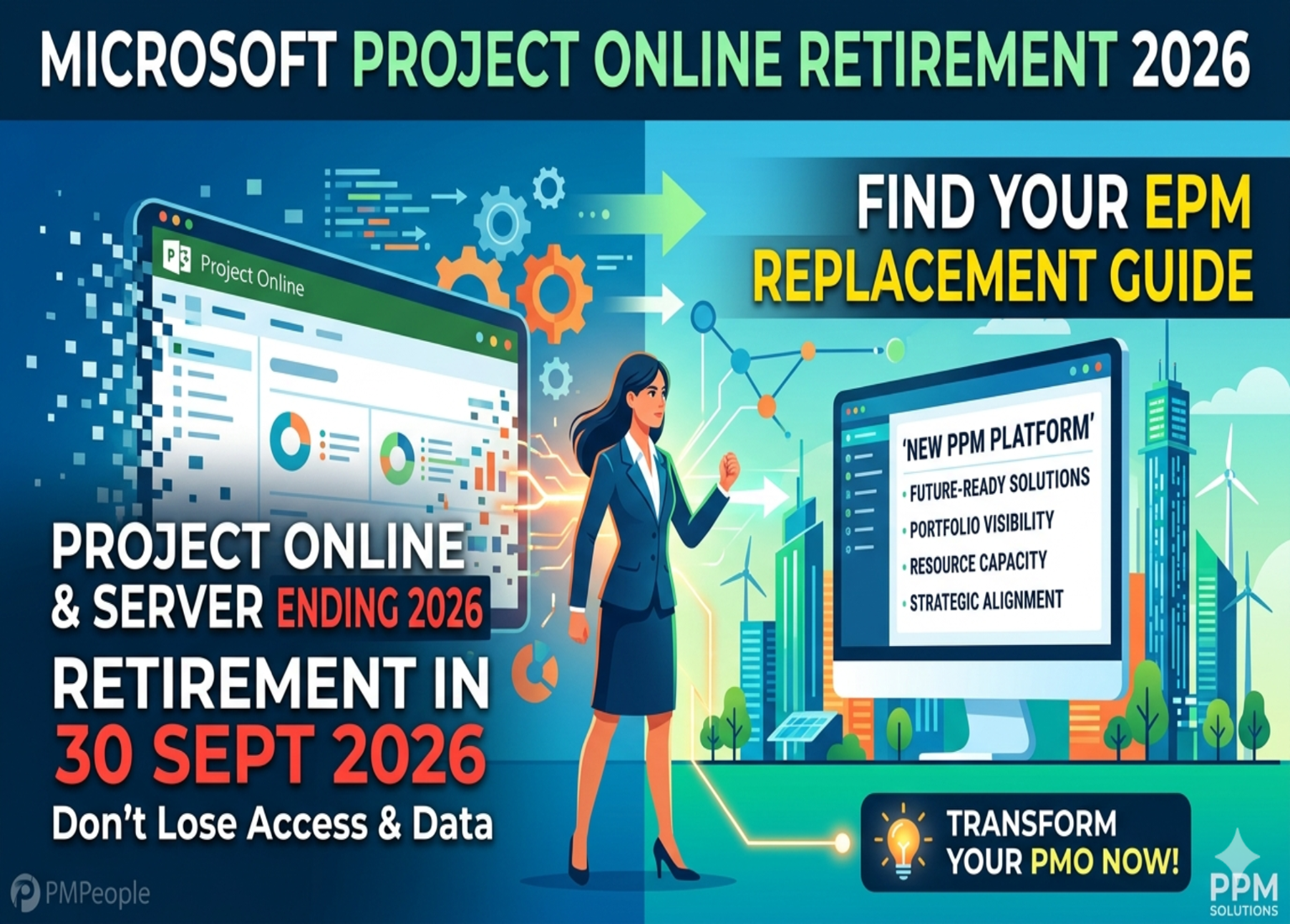
Microsoft Project Online will be fully retired on 30 September 2026, and organizations will lose access to the service and their data after that date if they have not migrated. At the same time, Project Server 2019 has already exited mainstream support and reaches the end of extended support on 14 July 2026, putting the classic Microsoft EPM stack at the end of its lifecycle.
For PMOs, portfolio leaders, CIOs, and delivery heads, this is more than a tool change. It is a once‑in‑a‑decade opportunity to redesign how projects, portfolios, and resources are governed and delivered.
What exactly is Microsoft retiring?
Microsoft is retiring its SharePoint‑based Project Online (PWA) service and steering customers toward Microsoft 365 work management tools such as Planner (including premium capabilities), Project for the Web, and solutions built on Power Platform. After 30 September 2026, Project Online environments will no longer be accessible, so tenants must export or migrate project and portfolio data in advance.
On‑premise, Project Server 2016 and 2019 both follow the fixed 10‑year lifecycle; Project Server 2019’s extended support ends on 14 July 2026, after which organizations will receive no further security or product updates.
Why this matters for serious PMOs (beyond “one more migration”)
Organizations that adopted Microsoft EPM rarely used it as a “simple scheduling tool.” It became the backbone for:
- Enterprise portfolio management and prioritization
- Resource capacity planning and allocation
- Demand/intake management and approval workflows
- Cost, budget, and benefit tracking
- Governance, stage‑gate control, and auditability
If you treat 2026 as a pure IT migration (“replace tool A with tool B”), you risk carrying forward the same bottlenecks: inconsistent data, low adoption, weak governance, and fragmented reporting. If you treat it as a PMO and portfolio transformation, you can upgrade not just the software, but the way your organization makes investment and delivery decisions.
Migration patterns: three realistic paths
1. Lift‑and‑shift (tool replacement only)
This is the “fastest path,” but usually the lowest value.
- Who does this?Organizations under hard time pressure, with limited PMO influence, or very low process maturity.
- What they do:Move projects, resources, and configurations from Project Online/Server into another PPM tool and replicate workflows as‑is.
- Risks:
- Old process issues and political constraints are re‑implemented in a shiny new system.
- Data models remain messy, limiting analytics and AI.
- Adoption fatigue (“new tool, same problems”).
Use lift‑and‑shift only as a temporary risk‑reduction measure, not as your long‑term strategy.
2. Process‑first transformation (recommended)
This is where mature PMOs and forward‑looking CIOs win.
- Who does this?Organizations that already think in terms of portfolio governance, strategic alignment, and benefits realization.
- What they do (high level):
- Redesign governance (stage gates, approvals, funding cycles, steering committees).
- Standardize templates, lifecycles, and KPIs.
- Clean up taxonomies (portfolios, programs, cost categories, resource roles).
- Only then select and configure the new PPM/EPM platform.
- Benefits:
- Higher project success rates and faster decision‑making.
- Clean, structured data that works well with analytics and AI.
- Clearer narrative for executives: “We’re upgrading how we deliver change,” not “we’re changing software.”
use the Microsoft EPM retirement as a trigger to modernize the operating model, not just the tooling.
3. Hybrid and phased transformation (for complex enterprises)
Large enterprises rarely have the luxury of a “big bang” change.
- Phase 1 – Stabilize:Identify critical portfolios (regulatory, revenue‑critical, board‑visible) and move them first into the new PPM/EPPM platform.
- Phase 2 – Optimize:Redesign intake, governance, resource, and financial processes; rationalize custom workflows and reports.
- Phase 3 – Scale:Extend the model across business units, geographies, and functions, integrating ERP, HRIS, CRM, DevOps, and data platforms.
This phased approach lowers delivery risk and allows the PMO to show incremental wins while heading toward the 2026 deadline.
Industry‑specific views
Infrastructure, construction, and EPC
Profile: Long‑duration, capital‑intensive projects, complex resource structures, contractors and subcontractors, and heavy cost and risk exposure.
What matters most in a Project Online replacement:
- Fine‑grained resource capacity and skills planning for engineering, site teams, and contractors.
- Cost and cash‑flow visibility (CapEx/OpEx), change‑order control, and claims management.
- Integration with ERP, procurement, BIM/5D, and scheduling tools.
For this ICP, “just Planner + Power BI” is rarely enough. You need a full EPPM layer that understands heavy engineering realities.
IT services, software, and consulting
Profile: Hundreds of concurrent projects, shared billable resources, time & material and fixed‑price engagements, utilization and margin‑driven business.
What matters most:
- Real‑time visibility into utilization, availability, and forecasted demand by role/skill.
- Tight linkage between delivery, timesheets, billing, and profitability.
- Portfolio‑level health across clients, practices, and regions.
Here, the winning replacement looks more like PPM + PSA, tightly integrated with Jira/Azure DevOps, CRM, and financials.
BFSI, public sector, and government
Profile: Strong regulatory and audit expectations, long approval chains, risk‑averse culture.
What matters most:
- Structured intake and stage‑gate governance with defensible approvals.
- End‑to‑end audit trails for decisions, scope changes, and funding.
- Standardized, board‑ready portfolio reporting.
This ICP must be very careful not to lose governance rigor when leaving Project Online/Server. A lightweight task tool without strong workflow and auditability is a step backwards.
Manufacturing, engineering, and industrial enterprises
Profile: Mix of CapEx programs, R&D, product development, and continuous improvement.
What matters most:
- Portfolio prioritization aligned with strategy, capacity, and financial constraints.
- Scenario planning (“what if we delay X?”, “what if we start Y earlier?”).
- Integration with PLM, MES, and operations systems.
For these organizations, the key is aligning the new PPM/EPM platform with both strategic planning and operational execution.
The Microsoft ecosystem after Project Online
Microsoft is pushing customers toward:
- Planner (including premium capabilities in Microsoft 365)
- Project for the Web and roadmap experiences inside Teams
- Power Platform (Power Apps, Power Automate, Power BI) for custom solutions and reporting
These tools can cover lightweight work management and some portfolio needs, especially when extended with Power Apps and Power Automate. However, even Microsoft and ecosystem partners acknowledge that there is no single 1:1 “Project Online replacement” that matches its full enterprise PPM/EPM breadth out of the box.
That’s why many organizations are combining the Microsoft 365 stack with a dedicated PPM/EPPM platform that natively integrates with Azure AD, Teams, and Power BI.
How PMPeople positions itself as a Microsoft EPM replacement
“Use Project Online/Server retirement to move to a modern, industry‑aware EPPM platform instead of another generic tool.”
PMPeople’s approach typically follows four stages:
-
- Assess
- Map your current Microsoft EPM footprint (Project Online/Server, PWA, SharePoint workflows, custom reports).
- Evaluate PMO maturity, governance, data quality, and integration points.
- Design
- Define a future‑ready PM framework using a 5D view of projects and portfolios (scope, time, cost, resources, risk/benefits).
- Standardize templates, lifecycles, KPIs, and approval flows for your ICP (EPC, IT services, BFSI, manufacturing, etc.).
- Select & implement
- Configure PMPeople as the core PPM/EPPM platform (or as the portfolio layer above other tools).
- Execute structured migration from Project Online/Server (data, workflows, reports) with phased pilots.
- Enable & scale
- Train PMs, resource managers, finance, and executives.
- Embed the new way of working and then scale across portfolios, regions, and business units.
- Assess
FAQs:
When is Microsoft Project Online retiring?
Microsoft Project Online retires on 30 September 2026. After that date, the service will be shut down and organizations will no longer be able to access their projects or data in Project Online.
Is there a direct Microsoft replacement for Project Online?
No. Microsoft recommends Planner (including premium capabilities), Project for the Web, and Power Platform solutions, but there is no single product that replicates the full enterprise PPM/EPM feature set of Project Online and Project Server.
What happens to Project Server?
Project Server 2016 and 2019 follow a fixed 10‑year support lifecycle, with extended support for Project Server 2019 ending on 14 July 2026. After that, organizations receive no security or product updates, increasing risk and compliance exposure.
What should PMOs do before 30 September 2026?
- Inventory where Project Online/Server is used and what depends on it.
- Decide whether to execute a lift‑and‑shift, a process‑first transformation, or a hybrid rollout.
- Select and pilot a fit‑for‑purpose PPM/EPPM platform, then migrate data and workflows.
- Train users and retire old integrations before the cutoff date.
Why not just move everything to Planner or Project for the Web?
Planner and Project for the Web are excellent for team‑level work management, but they lack deep enterprise capabilities such as advanced portfolio analysis, complex resource modeling, and strong governance and auditability needed in many PMOs. Most mid‑to‑large enterprises will still need a dedicated PPM/EPPM layer.