Role-Based Project Management Software
Bridging the Strategy-Execution Gap: Why Large Projects Fail at a 90% Rate
May 8, 2026
If you launch a small initiative with a budget under $1 million, statistics suggest you have a reasonable chance of success—roughly 76%. However, as the scope expands and the budget climbs above $10 million, that probability collapses. According to long-standing data from the Standish Group’s Chaos Report and subsequent market analysis, large-scale projects succeed only about 10% of the time.
This is not a margin of error; it is a systemic collapse. When nine out of ten major investments fail to deliver their projected value, on time and within budget, the issue is rarely a lack of technical skill or insufficient capital. The failure is structural.
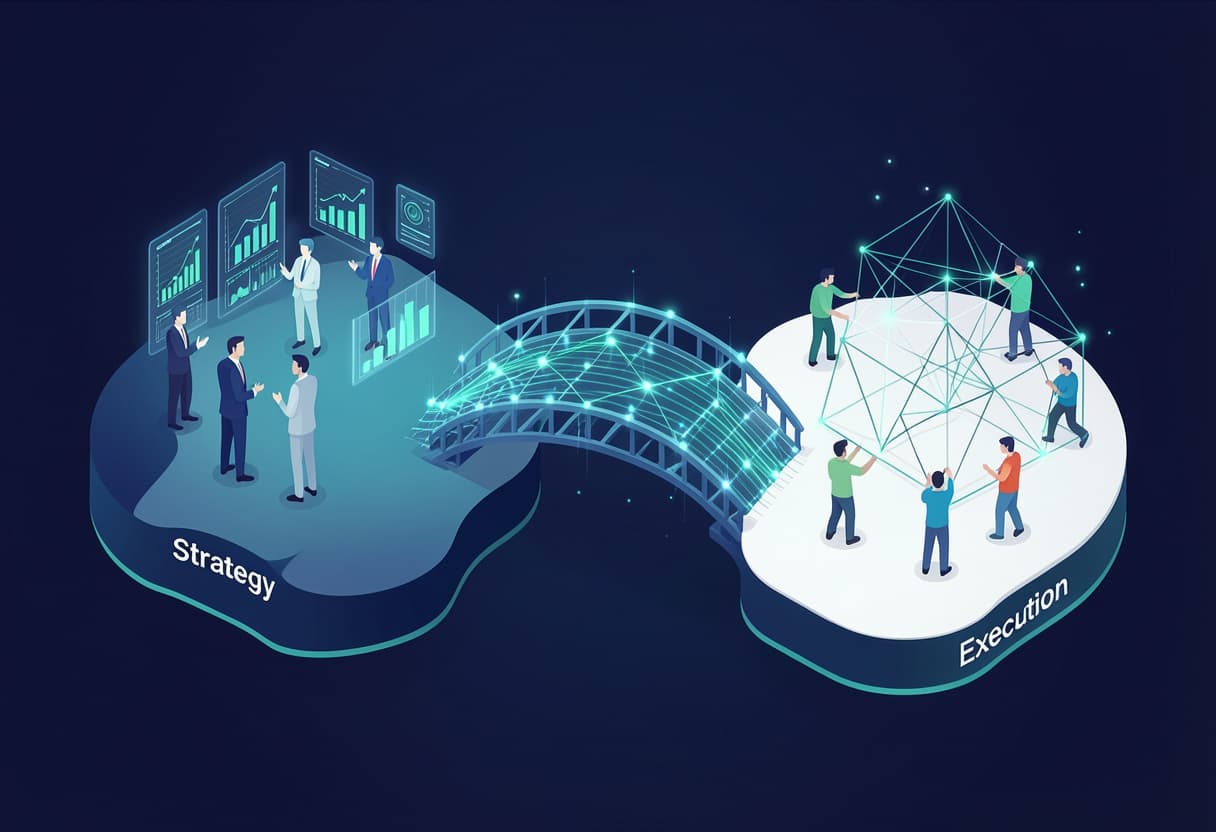
The culprit is the “Strategy-Execution Gap.” It is the void where executive vision dissolves before it reaches the people writing code, pouring concrete, or designing workflows. Bridging this gap requires moving beyond traditional project management into a more sophisticated, role-based approach to project portfolio management (PPM).
The Billion-Dollar Paradox
Why does scale correlate so strongly with failure? One might assume that larger projects attract the best talent and the most rigorous oversight. While true, scale introduces complexity that linear management methods cannot handle.
In a small project, the distance between the sponsor (the person paying) and the team member (the person doing) is short. Often, they are in the same room. The feedback loop is immediate. If the strategy shifts, the team knows instantly.
In a $10 million enterprise project, that distance becomes a chasm. Strategy is defined in the boardroom, translated by Portfolio Managers, segmented by Program Managers, assigned to Project Managers, and finally distributed to Team Members. At every handoff, context is lost. By the time a strategic directive reaches the execution layer, it often looks like a disjointed list of tasks with no clear connection to the original business case.
Conversely, when the execution layer encounters a roadblock, that reality rarely travels back up the chain effectively. Status reports are sanitized as they move upward—the “Green-Green-Green-Red” phenomenon—where a project looks healthy until the day before the deadline, when it suddenly crashes.
The Root Cause: A Disconnect of Dialects
The fundamental problem is that your organization is speaking two different languages.
- The Language of Strategy: Spoken by Portfolio Managers, Sponsors, and the PMO. They care about ROI, strategic alignment, risk exposure, and cash flow. They operate in quarters and fiscal years.
- The Language of Execution: Spoken by Project Managers, Resource Managers, and Team Members. They care about sprints, deliverables, dependencies, and bug bashes. They operate in hours and days.
Most organizations attempt to force these two groups into a single view, usually via a monolithic software tool or a sprawling spreadsheet. This fails because it serves no one. The C-suite finds the Gantt charts too granular and confusing, while the engineering team finds the portfolio dashboards abstract and disconnected from their daily reality.
This disconnect creates strategic misalignment. The team executes perfectly on tasks that no longer matter, or the executives make promises based on resource availability that doesn’t exist.
The Failure of "One-Size-Fits-All" Tooling
For decades, the software industry attempted to solve this with the “Super Tool”—complex ERP or PPM systems that forced every employee, from the CEO to the junior analyst, to log into the same interface.
These tools inevitably fail for two reasons:
- Friction: A developer does not want to navigate a complex governance interface just to mark a task as complete. They will resist the tool, leading to poor data entry.
- Noise: A sponsor does not need to see the comment thread on a specific ticket. When presented with too much data, they disengage.
When the official tool is too rigid, teams retreat to “Shadow IT”—usually Excel, email, or lightweight task managers. Once this happens, the single source of truth is lost. The Portfolio Manager is left making decisions based on data that is weeks old or entirely fabricated.
The Solution: Role-Based Management
To bridge the gap, organizations must abandon the idea of a single interface and embrace Role-Based Management. This approach acknowledges that different stakeholders need fundamentally different views of the same data.
In a mature PPM environment, the underlying data (the “truth”) is unified, but the user experience is segmented by function. This ensures that strategic alignment is maintained without forcing a cognitive overload on the users.
1. The Portfolio Manager and PMO
Their interface should focus on demand management, capacity planning, and financial forecasting. They need to see the aggregate health of investments against the corporate strategy. They require tools that align with PMBOK or PRINCE2 standards for governance, ensuring that the right projects are being executed.
2. The Project and Program Manager
This role requires control. They need views centered on scheduling, critical path analysis, and immediate resource conflict resolution. They are the translators who convert strategic objectives into work packages.
3. The Resource Manager
Often the most underserved role, the Resource Manager needs a specialized view focused on utilization, skills matrices, and availability. They answer the question: “Do we actually have the people to deliver this?”
4. The Team Member
The execution layer needs simplicity. Their interface should be a clean list of assignments, priorities, and time-tracking mechanisms. If the tool is cumbersome, they won’t use it. If they don’t use it, the data flowing up to the Portfolio Manager is wrong.
5. The Sponsor
Sponsors need a “Project Intelligence” view—high-level status, risk indicators, and financial burn rates. They should not have to hunt for this information. It should be pushed to them in a format that supports rapid decision-making.
Integrating Standards with AI-Driven Governance
Adopting a role-based structure provides the framework, but maintaining it requires rigorous project governance. Historically, governance has been synonymous with bureaucracy—endless forms and approval gates that slow down delivery.
This is where the convergence of professional standards (like PMBOK and PRINCE2) and Artificial Intelligence changes the equation.
Automating the Standards
PMBOK (Project Management Body of Knowledge) and PRINCE2 (PRojects IN Controlled Environments) provide excellent frameworks for managing large-scale complexity. They define the processes for risk, quality, and scope management. However, humans are bad at following processes consistently.
Modern PPM platforms are beginning to embed these standards directly into the workflow using AI. Instead of a Project Manager manually checking if a risk register is updated, an AI agent can analyze project communication and flag potential risks that haven’t been documented.
Predictive Governance
AI moves governance from reactive (auditing what happened) to predictive (warning what will happen). By analyzing historical performance data across the portfolio, AI models can predict that a project is trending toward failure weeks before a human manager would spot the variance in the schedule.
For example, platforms like PMPeople utilize specific AI models—such as a Project Intelligence Assistant or a Virtual PM Assistant—to guide users through standard procedures. This ensures that a project adheres to project governance protocols without the administrative burden usually associated with them.
The Trust Layer: Blockchain and Immutable Records
One of the hidden causes of project failure is the lack of accountability. Decisions are made, changes are approved, and scope is crept, but months later, no one can recall exactly who authorized what.
Advanced PPM solutions are now integrating blockchain technology to create a “Reliable Organization Seal.” This provides an immutable audit trail of status reports and approvals. When a stakeholder approves a scope change, that interaction is cryptographically sealed. This doesn’t just prevent disputes; it forces a higher level of integrity in reporting. When managers know the data is immutable, the “Green-Green-Green-Red” reporting style disappears, replaced by honest assessments of project health.
Conclusion: The Unified Truth
The 90% failure rate of large projects is not an inevitability. It is the result of trying to manage complex networks of people with simplistic, linear tools.
To bridge the strategy-execution gap, organizations must:
- Acknowledge the distinct roles involved in project delivery and provide them with specialized interfaces.
- Unify the data so that the Team Member’s task update instantly impacts the Portfolio Manager’s financial forecast.
- Automate governance by embedding standards like PMBOK and PRINCE2 into the workflow via AI.
- Ensure accountability through immutable records.
When Strategy and Execution are connected by a transparent, role-based infrastructure, the organization moves as one. The gap closes, and the failure rate drops.