Role-Based Project Management Software
Beyond Automation: How AI is Reshaping Portfolio Governance in 2026
March 3, 2026
The “Watermelon Project” has been the bane of executive leadership for decades. On the outside, the status reports are green—everything looks healthy, timelines are being met, and budgets are intact. But on the inside, the project is deep red. Risks are being ignored, technical debt is mounting, and team morale is plummeting. By the time leadership cuts into the project to see the truth, it is often too late to salvage the investment.
For years, the Project Management Office (PMO) has functioned as the quality assurance layer intended to prevent this scenario. Yet, despite rigorous methodologies and expensive software, the administrative burden of manual reporting often encourages the very opacity governance tries to eliminate. Project managers, overwhelmed by the need to update Gantt charts and chase timesheets, often default to “optimistic reporting” to buy themselves time.
As we look toward 2026, the landscape is shifting fundamentally. We are moving past the era of simple task automation—where tools merely digitized analog processes—into the age of AI-driven Portfolio Governance. While Gartner famously predicted that 80 percent of today’s project management tasks would be eliminated by 2030, the reality of 2026 suggests a more nuanced evolution. The work isn’t disappearing; it is moving up the value chain. The role of the project manager is transitioning from data gatherer to strategic architect, supported by systems that don’t just track history but predict the future.
This analysis explores how project management AI is redefining governance, the critical role of data integrity through blockchain, and why the human element remains the ultimate safeguard in an autonomous world.
The Evolution of the Project Intelligence Assistant
To understand the shift in 2026, we must look at the difference between passive tracking and active intelligence. Traditional PPM tools are passive repositories. They only know what a human tells them. If a project manager fails to log a risk, the system assumes the risk does not exist.
The Project Intelligence Assistant represents a fundamental change in this dynamic. It does not wait for input; it observes the digital exhaust of the project ecosystem to build a predictive risk model.
From Reactive Reporting to Predictive Modeling
Consider a scenario involving a large-scale infrastructure program. In a traditional setup, a delay in material delivery is only flagged when the vendor sends a notification or the site manager logs the issue. By then, the schedule has already slipped.
In a sophisticated AI-governed environment, the Project Intelligence Assistant operates differently. It analyzes disparate data points to forecast the delay weeks before it happens. It might correlate three subtle signals:
- Global Supply Chain Data: News reports indicate a strike at a major raw material port.
- Vendor History: The specific supplier has a historical pattern of being 15% late during Q3.
- Communication Sentiment: Email exchanges between the procurement officer and the vendor show an increase in vague language and delayed response times.
Synthesizing these inputs, the AI flags a “High Probability Schedule Risk” on the portfolio dashboard, despite the current status report reading “Green.” It allows the Program Manager to intervene, perhaps by activating a secondary supplier, before the critical path is impacted.
This is the core of project portfolio management in 2026: the ability to manage risks that haven’t happened yet. The AI acts as a radar system, scanning the horizon for turbulence that the human eye cannot see from the deck.
The Convergence of Project, Program, and Portfolio
One of the most persistent challenges in enterprise management is the disconnect between strategy (Portfolio), coordination (Program), and execution (Project). These layers often operate in silos, using different metrics and even different software tools.
AI is the universal solvent for these silos. By treating the entire enterprise hierarchy as a single data organism, AI models can trace the butterfly effect of a minor decision at the project level all the way up to the strategic portfolio level.
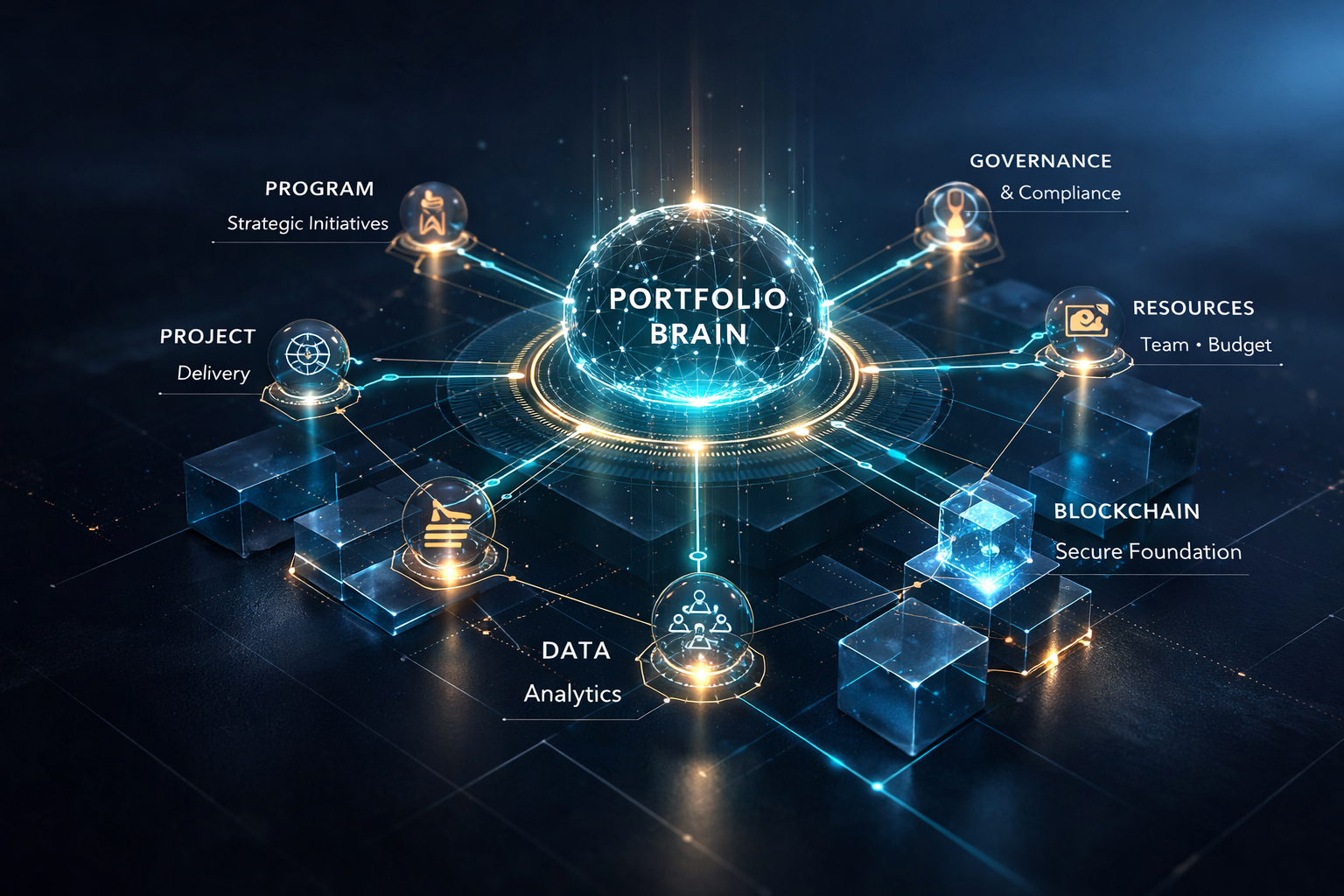
The “Portfolio Brain” Concept
Imagine a software development team decides to refactor a piece of legacy code to reduce technical debt. At the project level, this looks like a smart engineering decision. However, the AI, analyzing the project governance structure, recognizes that this specific code module is a dependency for three other projects in the portfolio, all scheduled for a synchronized release in two months.
The AI immediately highlights a “Strategic Misalignment.” It calculates that the refactoring work, while valuable, introduces a 40% chance of delaying the wider product launch, potentially missing a market window worth millions in revenue.
Without AI, this connection might only be realized during a chaotic integration testing phase weeks later. With AI, the Portfolio Manager receives an alert: “Project A decision conflicts with Portfolio Objective B.” This allows for a governance decision: approve the delay to improve quality, or postpone the refactor to hit the market window. The AI doesn’t make the decision; it ensures the decision is made with eyes wide open.
The Trust Protocol: Why Blockchain Matters in AI Governance
As organizations rely more heavily on project management AI, a new risk emerges: Data Integrity. AI models are only as good as the data they are fed. If a project manager retroactively changes a date to make a report look better, or if a stakeholder manipulates budget figures to hide an overrun, the AI’s predictions become flawed.
Furthermore, in industries like construction, healthcare, and government contracting, the “truth” is often a matter of dispute. When a project fails, who is to blame? The vendor? The client? The weather?
This is where the integration of blockchain technology becomes a non-negotiable component of modern PMO software.
The Immutable Audit Trail
Blockchain provides a “Reliable Organization Seal”—a guarantee that the data feeding the AI has not been tampered with. In platforms like PMPeople, this integration creates a permanent, immutable record of project reality.
Let’s examine how this works in practice:
- Status Reporting: When a project manager submits a status report, a hash of that report is recorded on the blockchain. It cannot be altered later to cover up a mistake. This forces a culture of honesty and transparency.
- Stakeholder Accountability: Approvals and change requests are cryptographically signed. A sponsor cannot claim, “I never approved that budget increase,” if their digital signature is verified on the chain.
- Investor Confidence: For startups or publicly traded companies, being able to prove the status of product development with blockchain-verified data provides investors with a level of due diligence that spreadsheets cannot match.
In 2026, AI provides the intelligence, but blockchain provides the trust. Without the latter, the former is susceptible to the age-old problem of “garbage in, garbage out.”
Reducing the Administrative Tax with Natural Language Agents
Governance has historically been expensive. It requires hours of data entry, report formatting, and meeting preparation. This “administrative tax” is the primary reason team members resist PMO processes. They want to do the work, not report on the work.
Natural Language Agents (NLAs) and Virtual Assistants are dismantling this barrier. By 2026, the interface for PMO software is no longer a complex form with fifty fields; it is a conversation.
The End of the Friday Status Report
Consider the workflow of a Team Member using a Virtual PM Assistant. Instead of logging into a portal at 4:55 PM on a Friday to fill out a timesheet and status update, the interaction happens organically throughout the week.
- The Assistant: “I noticed you committed code for the ‘Payment Gateway’ feature and closed Ticket #402. Did you encounter any blockers?”
- The Developer: “No blockers, but the API documentation from the vendor was outdated, so it took about two hours longer than expected.”
- The Assistant: “Noted. I’ve updated the task status to Complete, logged the 2 hours variance, and flagged the documentation issue as a risk for future integrations.”
This interaction accomplishes three things instantly:
- Zero Friction: The team member stays in their flow.
- Rich Data Capture: The system captures the reason for the variance (outdated documentation), not just the number.
- Real-Time Governance: The risk is logged immediately, not at the end of the week.
For the Project Manager, the Document AI Generator automates the creation of the Project Charter, Scope Statement, and even the final Lessons Learned report. The AI drafts these documents based on the accumulated data and chat logs, requiring the PM only to review and refine. This shifts the PM’s time allocation from 80% administration / 20% leadership to 20% administration / 80% leadership.
The Human-in-the-Loop: Governance in an Autonomous Age
With predictive modeling, blockchain verification, and automated administration, one might ask: Is the Project Manager obsolete?
The answer is a definitive no. In fact, the role is more critical than ever, but the nature of the work has changed. We are entering the era of Human-in-the-Loop Governance.
AI is excellent at processing data and identifying patterns. It is terrible at empathy, negotiation, and ethical judgment. A project management AI can tell you that a project is likely to fail if you don’t force the team to work weekends. It takes a human leader to decide that burning out the team is not an acceptable solution, even if the math says it’s the most efficient path to the deadline.
The Decision Matrix
In 2026, the governance model looks like a pilot flying a modern jet. The plane (the AI) handles the thousands of micro-adjustments required to keep the aircraft stable. It monitors fuel, wind speed, and engine temperature. But the pilot (the Portfolio Manager) decides where the plane is going and how to handle unexpected crises that the autopilot wasn’t programmed for.
Governance becomes a series of high-value decisions:
- Resource Arbitration: When two high-priority projects need the same expert, AI provides the data on impact, but a human negotiates the compromise.
- Strategic Pivots: When market conditions change, humans provide the vision for the new direction; AI recalculates the roadmap to get there.
- Stakeholder Management: AI can generate a report, but it cannot take a nervous client out to lunch and reassure them that the team is committed to their success.
Conclusion: The New Standard of Leadership
The transition to AI-driven portfolio governance is not merely a technical upgrade; it is a cultural shift. It demands transparency. It requires organizations to value truth over comfort. And it necessitates a platform that can handle the complexity of modern project delivery while keeping the user experience simple.
By 2026, the organizations that succeed will not be the ones with the hardest working project managers, but the ones with the most intelligent governance systems. They will utilize tools that combine the predictive power of AI with the immutable trust of blockchain, freeing their human talent to focus on what humans do best: leading, innovating, and solving complex problems.
If your organization is ready to move beyond simple automation and embrace true project intelligence, it is time to evaluate your toolset. You need a platform that understands the nuances of the PMBOK® and PRINCE2 standards while delivering the cutting-edge capabilities of Generative AI and blockchain security.
Experience the future of Portfolio Management today. Start using PMPeople for free and transform how your organization governs success.