Role-Based Project Management Software
Beyond Administration: How AI is Reshaping the Project Manager Role in 2026
May 11, 2026
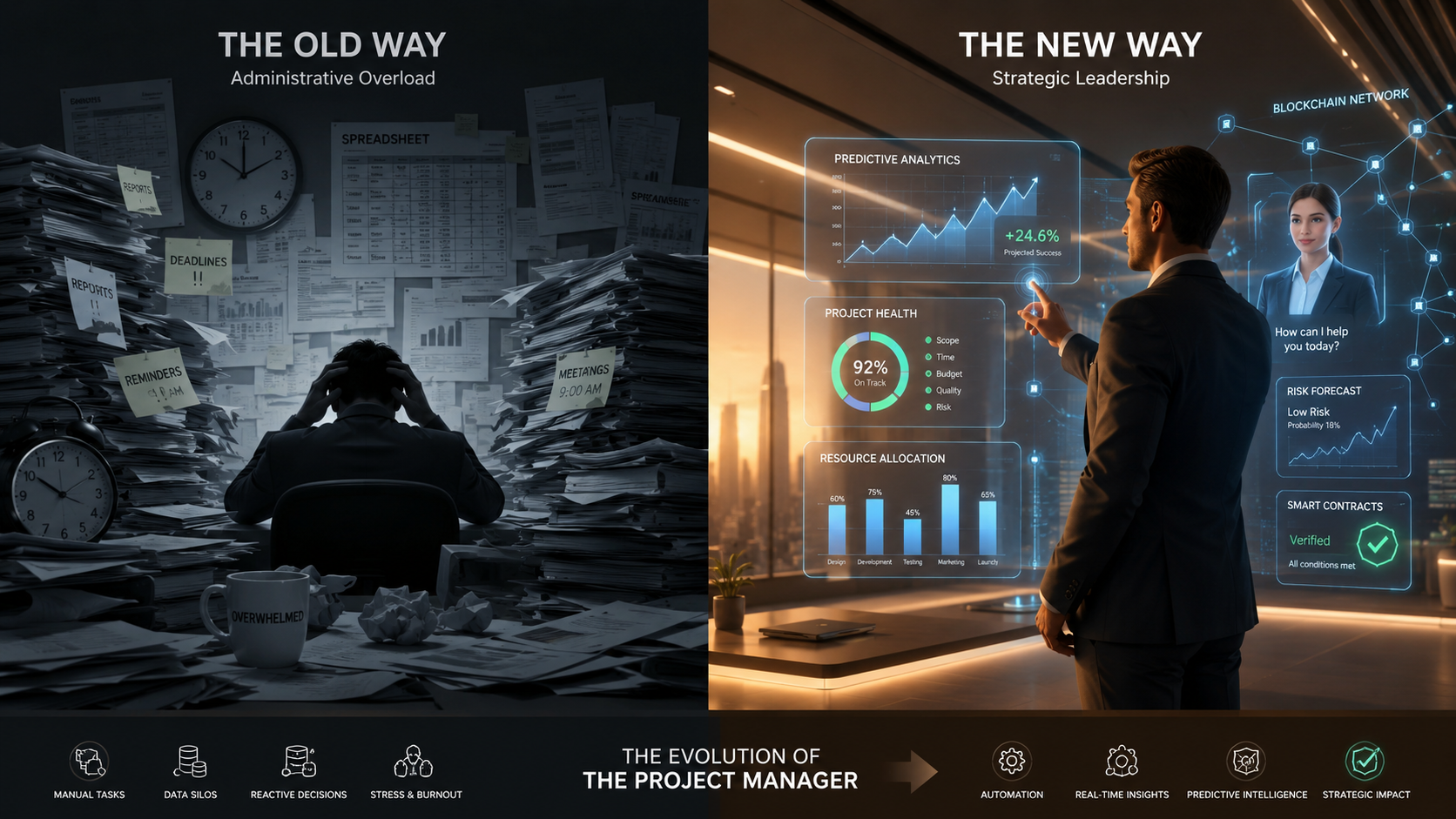
In 2019, Gartner made a prediction that sent ripples through the project management community: by 2030, 80% of the tasks involved in today’s project management discipline would be eliminated by artificial intelligence. It was a bold claim, suggesting that the vast majority of a project manager’s day—data collection, tracking, reporting—would simply evaporate.
We are now in 2026, and looking at the current state of the industry, it appears Gartner may have been conservative. We are not waiting for 2030; the shift has already occurred. The administrative heavy lifting that defined the role for decades is being systematically dismantled by AI project management systems that do not sleep, do not make calculation errors, and do not sugarcoat status reports.
For the project management professional, this is not an extinction event, but an evolutionary bottleneck. The managers who survive this transition are those who understand that their value no longer lies in maintaining the schedule, but in delivering the strategy.
The Death of the Schedule Maintainer
For nearly half a century, the archetype of the project manager was the “Gantt Chart Gardener.” This individual spent hours every week chasing team members for updates, manually adjusting dependencies in a spreadsheet or legacy software, and formatting slide decks for steering committees. This work was necessary, but it was low-value. It was administrative overhead masquerading as management.
In 2026, this archetype is obsolete. Modern project management AI has taken over the tactical execution of monitoring and controlling. Algorithms now ingest real-time data from code repositories, communication platforms, and financial systems to predict project health with a degree of accuracy no human can match.
Consider the shift in risk management. Previously, a risk register was a static document, updated perhaps once a month during a meeting. Today, predictive models analyze historical performance data across the entire portfolio. They identify that a specific vendor tends to delay shipments by three days during Q3, or that a specific development team’s velocity drops by 15% when working on legacy code integration. The AI flags the risk before it materializes and suggests mitigation strategies.
The project manager is no longer the person asking, “Is this task done?” The system already knows it is done. The project manager is now the person asking, “Does this completed task actually move us closer to the business objective?”
The Trust Paradox: Why Blockchain Matters in an AI World
As we delegate more reporting authority to algorithms, a new problem emerges: the provenance of data. If an AI agent generates a status report claiming a project is “Green,” stakeholders need to trust the underlying data is accurate and has not been manipulated to hide bad news.
This is where the intersection of AI and immutable ledgers becomes critical. We are seeing a rise in platforms that utilize blockchain technology to create a “Reliable Organization Seal.” In this ecosystem, every status change, every budget approval, and every resource allocation is timestamped and cryptographically sealed. This creates an immutable audit trail.
For the project manager, this removes the burden of proving the data is real. The system provides the evidence. This is particularly vital in regulated industries like healthcare, finance, and government, where compliance is non-negotiable. When a resource management tool is backed by blockchain, the dispute over “who said what when” disappears, allowing the human manager to focus on conflict resolution rather than fact-finding.
Skill Gap Analysis: The Rise of Soft Power
With the administrative burden lifted, a vacuum has been created in the project manager’s daily schedule. How that time is filled determines the success of the modern PM. The industry is witnessing a massive pivot toward “soft skills,” though the term minimizes their difficulty and importance. We should call them “strategic competencies.”
1. Negotiation and Influence
AI can calculate the optimal resource allocation, but it cannot convince a functional manager to release a key engineer to your project. It cannot negotiate the nuances of scope creep with a client who feels unheard. As the technical barriers lower, the interpersonal barriers become the primary friction point. The PM of 2026 must be a diplomat first and a technician second.
2. Strategic Alignment
Project success used to be defined by the “Iron Triangle” of time, cost, and scope. You could deliver a project on time and on budget that was a complete failure because it didn’t solve the business problem. AI manages the Iron Triangle. The human manager must manage the “Value Triangle.” This requires a deep understanding of organizational strategy. The PM must constantly align the project’s outputs with the company’s shifting strategic goals.
3. Emotional Intelligence (EQ)
Teams are under pressure. Burnout is a constant threat in high-velocity environments. An algorithm can flag that a resource is over-allocated, but it cannot detect that a team member is disengaged due to a lack of career growth or personal stress. The ability to read the room, build psychological safety, and motivate diverse teams is the unassailable fortress of the human manager.
Tooling Evolution: From Menus to Agents
The user interface of project management software has undergone a radical transformation. The days of navigating complex nested menus to find a specific report are ending. We have entered the era of the Natural Language Agent.
In 2026, interacting with a project management methodology platform looks less like data entry and more like a conversation. A Program Manager might type—or simply say—”Show me all projects in the EMEA region with a CPI below 0.9 and draft an email to the sponsors explaining the variance based on the latest risk logs.”
This capability, often referred to as a Virtual PM Assistant, relies on Large Language Models (LLMs) integrated directly into the PPM core. These assistants do not just retrieve data; they synthesize it. They can:
- Summarize Documentation: Instantly digest hundreds of pages of requirements to answer specific questions about scope.
- Generate Artifacts: Draft project charters, risk management plans, and lessons learned documents based on templates and historical data.
- Facilitate Onboarding: Act as a 24/7 mentor for new team members, answering questions about process and protocol without consuming senior staff time.
Platforms like PMPeople have pioneered this approach by integrating multiple AI models—dedicated to document generation, project intelligence, and help documentation—ensuring that the tool adapts to the user, not the other way around. This velocity is essential. In a competitive market, the time spent clicking buttons is time lost delivering value.
Redefining Methodology: The Hybrid Reality
The debate between Waterfall and Agile was largely a debate about how to manage uncertainty and administrative control. Project management methodology in 2026 is fluid. AI allows for a “predictive agile” approach.
Teams can work in iterative sprints (Agile), while the AI analyzes velocity and backlog refinement to project long-term timelines with Waterfall-like predictability. The rigid walls between methodologies have crumbled. A resource management tool today must handle a construction project (predictive) and a software development project (adaptive) within the same portfolio without forcing a square peg into a round hole.
This hybrid reality requires a PM who is methodologically agnostic. They must treat methodologies as a toolkit, selecting the right framework for the specific problem, knowing that the AI layer will handle the translation of data up to the portfolio level.
Future Outlook: From Project Manager to Value Delivery Lead
As we look toward the end of the decade, the title “Project Manager” is becoming increasingly inaccurate. “Management” implies control and administration—tasks that are being automated. “Project” implies a temporary endeavor, whereas modern business focuses on continuous product lifecycles.
We are seeing the emergence of the “Value Delivery Lead.” This role is accountable for outcomes, not outputs. They do not report on how many lines of code were written; they report on the customer retention impact of the new feature.
This evolution requires a mindset shift:
- From Output to Outcome: Stop measuring busy work. Start measuring business impact.
- From Enforcer to Servant Leader: Stop chasing timesheets. Start removing blockers.
- From Reporter to Analyst: Stop reading the news. Start interpreting the forecast.
Conclusion
The Gartner prediction of 2019 was a warning, but it was also an invitation. By eliminating 80% of the routine work, AI has given project managers the gift of time. The question is not whether the technology will take your job, but whether you are willing to evolve into the role that remains.
The future belongs to those who can leverage AI project management to handle the science of the profession, while they master the art. It belongs to those who use blockchain-backed tools to ensure trust, natural language agents to increase velocity, and emotional intelligence to lead people.
The administrative era is over. The strategic era has begun.