Role-Based Project Management Software
Back to Blog
Move Projects From Bureaucracy to Business Results
By Jose Barato
February 6, 2025
3 minutes read

Nowadays, value-driven Project Management Offices (PMOs) no longer need strict adherence to processes. Merely enforcing procedures or requesting documents from project teams does not guarantee their performance. Similarly, expecting managers to make timely decisions solely based on reading reports is ineffective. PMOs that rely on these practices are often perceived as cost centers by senior management. During crises, such PMOs are often downsized, outsourced, or eliminated.
To deliver value, PMOs must allocate their time to anticipating problems and governing the project portfolio. By shifting the management burden to project teams, PMOs can significantly enhance their effectiveness without increasing resources. This shift can commence by instilling three simple habits in Project Managers:
- Project Managers generate easy and frequent project status reports.
- Project Managers are accountable in regular project review meetings.
- Project Managers serve multiple stakeholders who can monitor the project at their convenience (the “panopticon” effect).
1. Easy and Frequent Project Status Reports
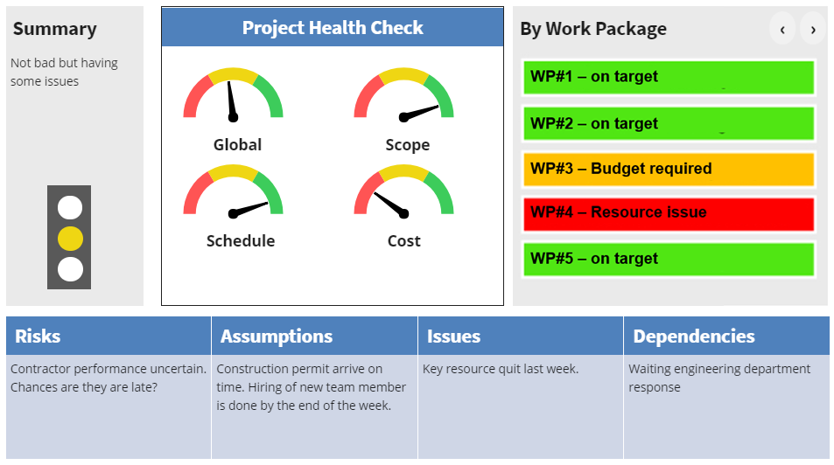
Hypothesis: Project Control is achieved through simple reports aimed at “Measuring and taking corrective/preventive actions”.
If reports are labor-intensive and time-consuming to write, they won’t be done when they won’t be prioritized during busy periods. Solution: online reports:
- Significant management facts should be updated promptly, with report preparation taking only a few minutes (by modifying previous reports). Past reports should remain accessible to stakeholders.
- Relevant project status information (costs, dates, milestones, risks, etc.) should be conveyed in an executive format, at an appropriate aggregation level, providing informative insights for management (typically less than 20 work packages), on a bi-weekly or monthly basis.
- Project status reports should be self-explanatory, quick to produce, and available online (downloadable as PDFs, with online access available on computers or mobile devices).
- Project status reports are a means to support project management, not an end in themselves.
2. Regular Project Review Meetings

Hypothesis: Effective Project Governance is achieved through face-to-face conversations with Project Managers.
Project Managers should report to the PMO periodically, even when projects are progressing smoothly:
- Review meetings should not simply involve sending reports to be read later but should instead be interactive sessions, lasting around 30 minutes, conducted with the PMO rather than immediate supervisors. These sessions hold the Project Manager accountable, and governance leaders gain a comprehensive understanding of the project’s status, suggesting preventive or corrective actions.
- The project review meeting typically consists of three brief sections:
- Summary of work completed in the previous period.
- Summary of work planned for the upcoming period.
- Performance assessment, with a focus on discussing risks, proactively offering solutions, and collectively determining the next steps.
3. The Panopticon Effect

Hypothesis: If Project Managers feel many eyes monitoring their project, then they will be more effective as professional Project Managers.
Stakeholder engagement is crucial to project success. The “panopticon effect” involves having vigilant oversight of projects, allowing stakeholders to view project statuses from their computers or mobile devices at any time:
- Current technology enables the engagement of an unlimited number of stakeholders in projects, providing them with transparent access to authorized information to make comments, provide feedback, request changes, etc. Stakeholders can view project statuses independently, without the Project Manager’s involvement, and can access explanations for delays, overruns, problems encountered, risks, etc.
- Managers and the PMO can monitor management activities in real-time. Project Managers who sense this scrutiny are incentivized to provide explanations, not only for consistency but also as a means to involve leadership. Project Managers should remember that the project belongs to the organization, not solely to themselves. When a crisis arises, they can refer back to previous reports to demonstrate proactive management and response to anticipated issues.